

Meat the Future
Exhibition Redesign (Food Museum, 2023–24)
Graphic Design & Spatial Adaptation
About the exhibition
Meat the Future was a year-long exhibition at the Food Museum (May 2023–May 2024) examining the environmental impact of meat production and how our diets may evolve. Originally developed by the Oxford University Museum of Natural History and the LEAP research programme, the award-winning exhibition content arrived with an existing visual identity and structure that needed reimagining for the site.

Considerations
Designing for a new venue required balancing several priorities:
Working within an existing identity while adapting it to suit a different gallery footprint, wall proportions, and visitor flow.
Using the Food Museum’s collection to anchor the content in a local, tangible context.
Ensuring interpretation was clear and visually coherent for mixed audiences with varied engagement levels.
Introducing new themes—regenerative farming, plant-based diets, and alternative proteins—without disrupting the original exhibition’s continuity.
Guaranteeing absolute production accuracy, as we’d decided most walls were to be delivered as full-height vinyl wallpaper rather than mounted panels.




Key components & design decisions
1. Spatial layout & narrative flow
I reshaped the gallery’s narrative path to form a clear journey: environmental context → contemporary meat-production practices → cultural and social aspects → future food solutions. This required revisiting circulation, repositioning sections, and aligning graphics with the museum’s irregular room shapes so visitors could intuitively follow the story.
2. Colour, hierarchy & interpretation clarity
The exhibition already featured bold typographic markers, which I kept. To differentiate sections more effectively, I selected a blue background tone to sit alongside the original yellow, taken from the original exhibition colour palette. This created distinct thematic zones while preserving a cohesive, continuous palette throughout the space.
3. Full-wall vinyl design & technical precision
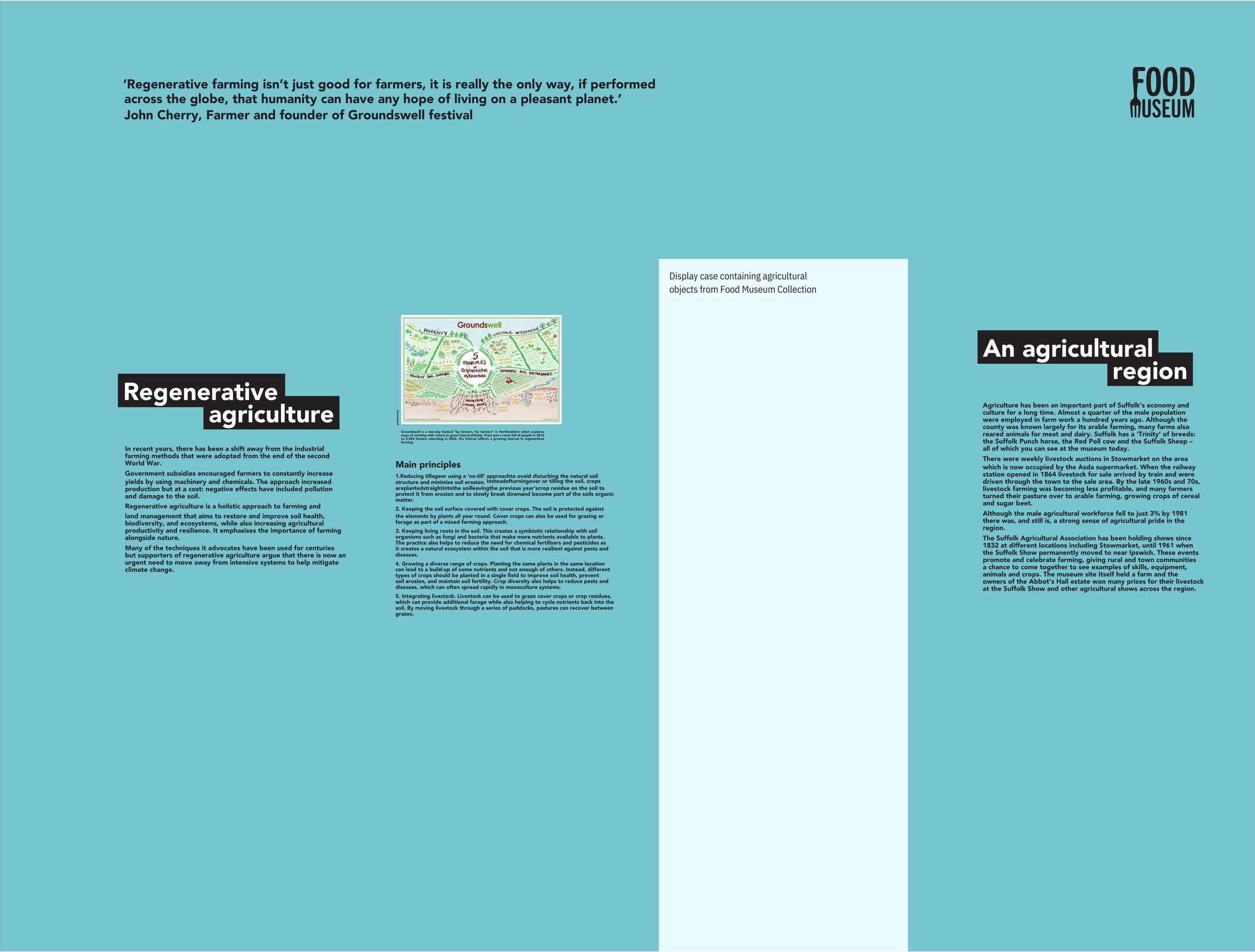
A major part of the project involved producing full-wall vinyl wallpaper for almost every surface. I measured each wall on-site and rebuilt the architecture inside InDesign at exact scale. This allowed me to design text, graphics, and object placements directly onto their true dimensions.
Because the vinyls covered entire walls, the layouts had to be finalised before printing—with no room for adjustment during installation. Every measurement, bleed, join, and alignment point needed to be 100% accurate, ensuring a seamless result once the material was pasted directly onto the gallery walls.
4. Additional content & new graphic elements
To expand the exhibition, I created new panels and visual explanations on regenerative farming, plant-based diets, and alternative proteins. These elements were designed to blend smoothly with the inherited aesthetic, adding depth and a future-focused tone.
5. Object-led storytelling
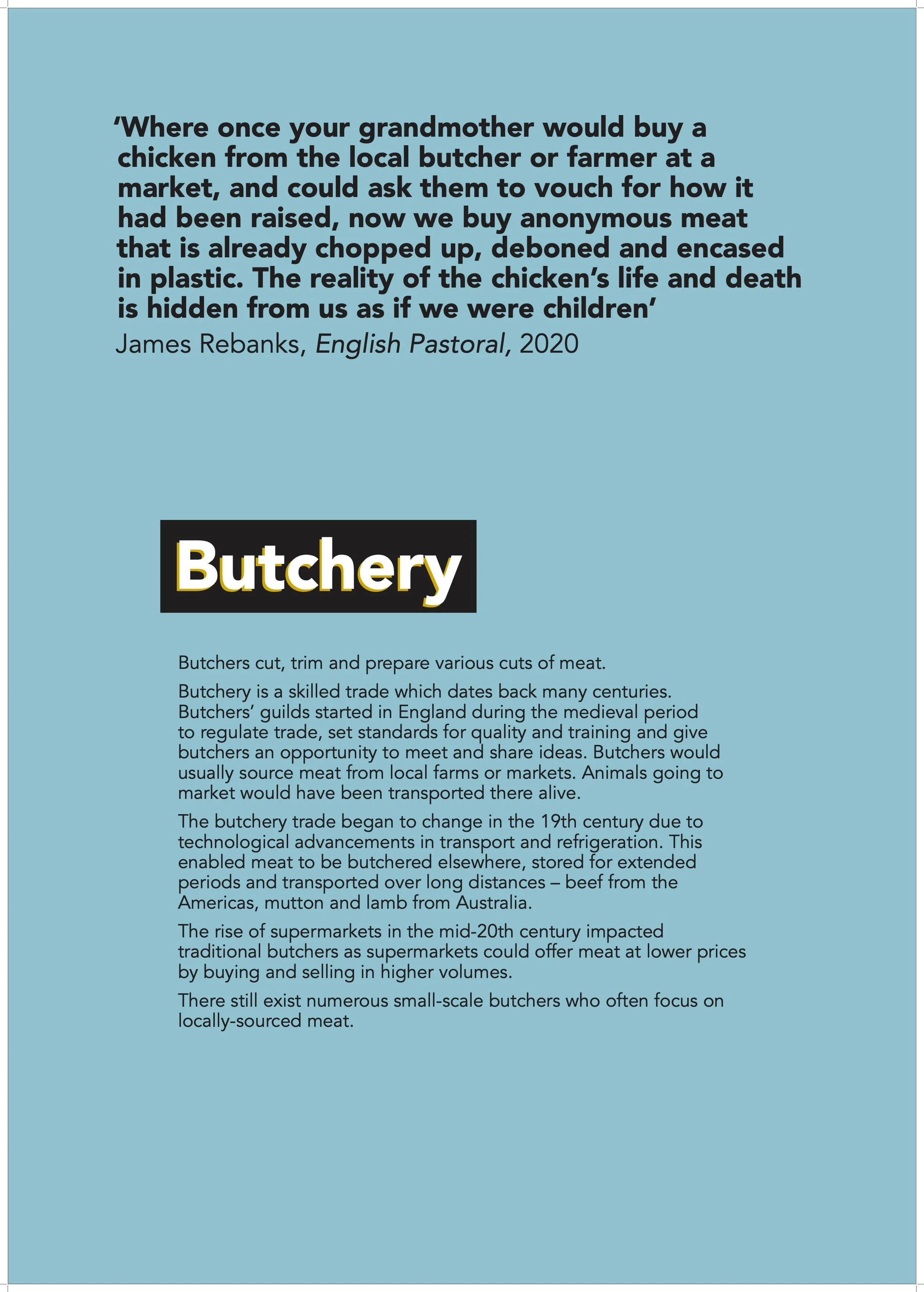
I incorporated objects from the Food Museum’s collection—such as a historic butcher’s block—into the narrative. These items were not just displayed but used as interpretive surfaces, grounding global research in familiar, local stories.
6. Interactive audio design
Working with an audio design company, I developed a “listening table” featuring interviews I recorded with farmers, researchers, and producers. I designed the interface and physical housing to be tactile, inviting, and aligned with the rest of the exhibition’s visual language.


Outcome
The result was a cohesive, engaging exhibition that felt native to the Food Museum’s spaces while delivering a clear, compelling narrative. It also acted as a successful continuation of the original Oxford design language, retaining its visual identity while adapting it with new, site-specific interventions.

